
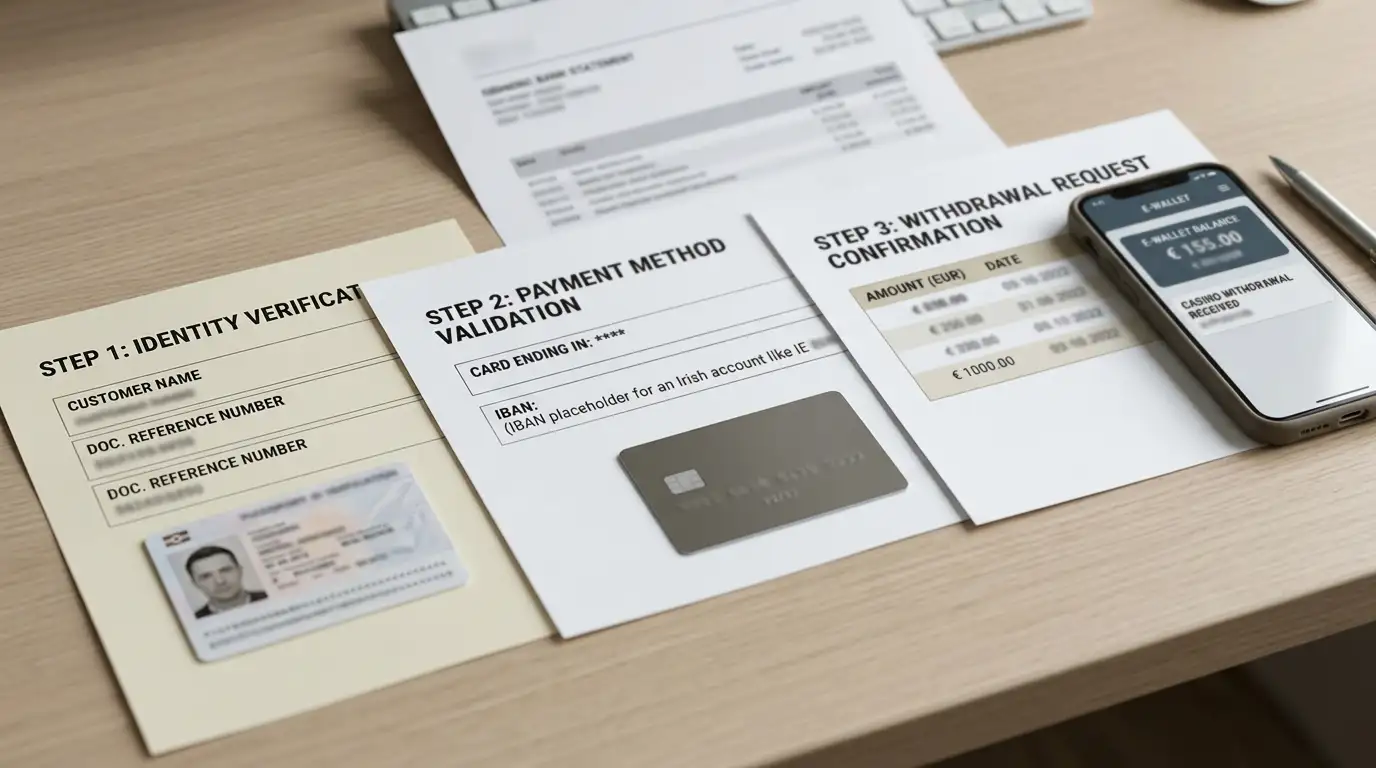
OneCasino withdrawals for players in Ireland
 Available in GB
OneCasino’s cashout flow is shaped by payment verification, ownership checks and the route used for the original deposit. The casino charges no withdrawal fee, and withdrawals do not carry a general cashout cap. Those headline points are useful, but the practical friction sits elsewhere: the player may need to complete a refundable verification deposit, the withdrawal normally follows the deposit method, and third-party funding can create a direct eligibility problem.
Timing also depends on the method rather than a single universal promise. Published figures span different method-dependent windows, so route and processing stage matter more than a single headline number. Treating those figures as route-specific estimates gives a more realistic picture than reducing every cashout to one fixed duration.

Table of Contents
- The withdrawal flow starts with payment verification
- Own-name funding protects the cashout route
- Withdrawal size is less constrained than the verification steps
- Processing time varies with the payment method
- The deposit route usually determines the return route
- Questions about OneCasino withdrawals
- Cashout friction is mostly about route and verification
The withdrawal flow starts with payment verification
OneCasino’s financial information describes a one-time €10.01 payment-verification deposit before withdrawal. The amount is refunded, so it functions as a verification step rather than a withdrawal charge. That distinction matters because the casino separately states that it does not charge deposit or withdrawal fees.
The same account material also says a player must have deposited at least €10 before the first withdrawal. For an Irish account, the useful reading is procedural: the first cashout can involve both the underlying deposit history and the separate refundable €10.01 payment-verification movement. These are published account steps, not a reason to treat €10.01 as a fee deducted from the withdrawal.
Verification is also connected to account ownership. A clean withdrawal trail is easiest when the payment instrument, casino account and identity information all belong to the same person. The account and verification guide covers the document categories OneCasino may request, including ID, utility bills, payment-card copies and source-of-funds information.
- Use a payment account or instrument held in your own name.
- Complete the required deposit history before requesting the first withdrawal.
- Expect the one-time €10.01 payment-verification deposit where the published process applies.
- Keep the same payment details available for the return route.
- Retain transaction records until the withdrawal has reached the receiving account.
The practical consequence is that the withdrawal request should be treated as the end of a payment chain, not as an isolated transfer. Earlier deposit ownership and verification can determine which return route is available later.
Own-name funding protects the cashout route
OneCasino’s terms require deposits to come from an account or payment instrument in the player’s own name. Third-party deposits can lead to a refused withdrawal or an account block. That makes payment ownership one of the most important operational rules in the cashout process.
A common example is a player using another person’s card, bank account or e-wallet to fund the casino account. Even when the deposit reaches the balance successfully, the mismatch can surface later when the operator checks the withdrawal destination. The safer administrative pattern is simple: the name on the funding instrument should match the casino account holder.
- Card funding: use a card issued to the casino account holder.
- Bank funding: keep the sending bank account in the same name as the player account.
- E-wallet funding: use an e-wallet controlled by the same account holder.
- Withdrawal records: preserve statements or transaction references that show the payment trail if an ownership check is requested.
The rule also explains why changing payment methods midstream can create extra checks. A withdrawal is not automatically free to move to any destination simply because that destination is convenient. The operator’s same-method policy ties the return route back to the deposit path.
For a broader view of cards, bank transfers, paysafecard, Skrill and euro handling, see the OneCasino payment methods guide. The payment page covers the funding side, while this page focuses on what happens when money moves back out.
Withdrawal size is less constrained than the verification steps
OneCasino withdrawals do not carry a general withdrawal cap in the payment profile used here. In practical terms, the more relevant constraints are payment ownership, verification, method compatibility and processing time.
A no-limit listing should not be confused with an instant transfer or a guarantee that every payment rail can handle every amount in the same way. Banks, cards and e-wallets operate with their own technical rules, and a method that works for a deposit may need a different return route if it cannot receive the withdrawal directly.
| Cashout factor | Published condition | Practical effect |
|---|---|---|
| Casino withdrawal fee | No withdrawal fee | The casino does not add a withdrawal charge. |
| Withdrawal cap | No general withdrawal limit | Verification and route compatibility matter more than a general casino cap. |
| Payment verification | One-time €10.01 refundable deposit | A verification step can precede the cashout. |
| Payment ownership | Funding must come from the player’s own payment instrument | A third-party deposit can block or derail the withdrawal. |
| Return method | Generally follows the deposit method | The original funding route can determine where the cashout is sent. |
The no-limit listing also makes record-keeping more useful than chasing a headline maximum. For larger withdrawals, the account may still face ordinary identity, source-of-funds or payment checks under the published terms. Those checks concern account and transaction verification rather than a universal cashout ceiling.
Processing time varies with the payment method
OneCasino’s help centre says withdrawals can take up to 48 hours on business days after processing, depending on the method. AskGamblers lists a 0–96-hour range across methods. Read together, those figures show why a single withdrawal time is a poor substitute for the route-specific process: the receiving method, processing stage and business-day timing can all change the elapsed time.
The important distinction is between the casino’s processing step and the time taken by the receiving payment service. A withdrawal can leave the operator’s workflow and still need time to settle through a bank, card or e-wallet channel. That is one reason a no-fee policy does not imply identical speed across all methods.
- Request: the player submits the withdrawal.
- Verification: payment ownership or account checks may need to be completed.
- Processing: the operator handles the approved cashout through the available route.
- Settlement: the receiving bank or payment service posts the funds.
Because the timing figures are method-dependent, it is better to track the actual payment route and the stage of the withdrawal than to assume every request should arrive within the same fixed window. A player comparing elapsed time should also distinguish business days from calendar days.
Bonus status can affect account activity in separate ways. The bonus guide explains the wagering and max-bet rules that apply while a bonus is active; those rules should be considered independently from ordinary payment processing.
The deposit route usually determines the return route
OneCasino generally sends withdrawals through the same method used for the deposit. When the original method cannot receive a refund or payout, the withdrawal can be redirected to a bank account. This gives the cashout flow a simple hierarchy: use the original method when it can accept the return, then use bank routing where the payment rail cannot receive funds.
That hierarchy explains why the initial deposit choice has consequences beyond funding convenience. A player who deposits by card, bank or e-wallet is also establishing the payment history that the operator can use when deciding where a later withdrawal belongs.
- Same method first: the deposit route is the default return route where supported.
- Bank fallback: a bank account can be used when the original method cannot receive the withdrawal.
- Matching ownership: payment instruments should remain in the player’s own name.
- No casino withdrawal fee: routing rules are separate from the casino’s fee policy.
The most useful preparation is administrative: keep payment details consistent, preserve the original funding record and complete any verification request promptly. That reduces uncertainty about where the withdrawal should go and which account relationship the operator is checking.
Questions about OneCasino withdrawals
Does OneCasino charge a withdrawal fee?
OneCasino charges no withdrawal fee. A bank, card issuer or e-wallet can still have its own currency-conversion or service costs.
How does OneCasino route withdrawals?
Withdrawals generally follow the payment method used for the deposit. If that method cannot receive the return payment, the withdrawal can be routed to a bank account.
What is the €10.01 verification deposit?
OneCasino describes a one-time €10.01 payment-verification deposit before withdrawal and says that amount is refunded.
How long can a OneCasino withdrawal take?
Timing varies by method. The timing range runs from 0–96 hours depending on the route, while OneCasino’s own help centre gives up to 48 hours on business days after processing. These are timing indications, not a guaranteed completion time.
Cashout friction is mostly about route and verification
OneCasino’s withdrawal setup combines a no-fee policy and a no-limit listing with stricter operational rules around ownership, verification and same-method routing. The €10.01 verification deposit is refundable, and the published timing figures depend on method. For an Irish player, the clearest way to manage the process is to keep the payment trail in one name, understand the route used for the deposit and judge elapsed time against the actual cashout method rather than a universal speed claim.
Read next
Created by the ”OneCasino” editorial team.